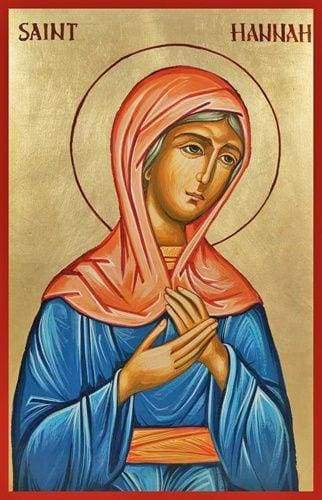
Saint Hannah

t garcia's avatarThe Apostolate of Hannah's Tears


Saint Hannah’s Story, go to the Holy Bible, Old Testament,1st Samuel chapter 1-3.

Feast celebrated: December 9
(in the Orthodox Church)
Patron Saint of Childless Wives

The Holy Prophetess Hannah dwelt in marriage with Elkanah, but she was childless. Elkanah took to himself another wife, Phennena, who bore him children. Hannah grieved strongly over her misfortune, and every day she prayed for an end to her barrenness, vowing to dedicate her child to God.
She went to the Temple and prayed fervently, but the priest Heli thought that she was drunk and began to reproach her. But Hannah poured out her grief, and after she received a blessing, she returned home. After this, Hannah conceived and gave birth to a son, whom she named Samuel (which means “Asked from God”).
When the child reached the age of boyhood, his mother presented him to the priest Eli, and Samuel remained…

View original post 564 more words

Happy Feast Day, Saints Hannah and Juan Diego, Intercessors for Life

t garcia's avatarThe Apostolate of Hannah's Tears

December 9th

Saint Hannah and Blessed Juan Diego are remembered in our hearts today as they both suffered with fertility problems within their marriages. Hannah begged God at the foot of the altar for a child and Juan Diego and his wife would be called in another way to bear fruit. To each soul God has a different plan.

May each of us accept God’s holy will for our lives today and give thanks.

St. Hannah bringing Samuel into the temple

The Holy Prophetess Hannah dwelt in marriage with Elkanah, but she was childless. Elkanah took to himself another wife, Phennena, who bore him children. Hannah grieved strongly over her misfortune, and every day she prayed for an end to her barrenness, vowing to dedicate her child to God.

She went to the Temple and prayed fervently, but the priest Heli thought that she was drunk and began to reproach…

View original post 120 more words

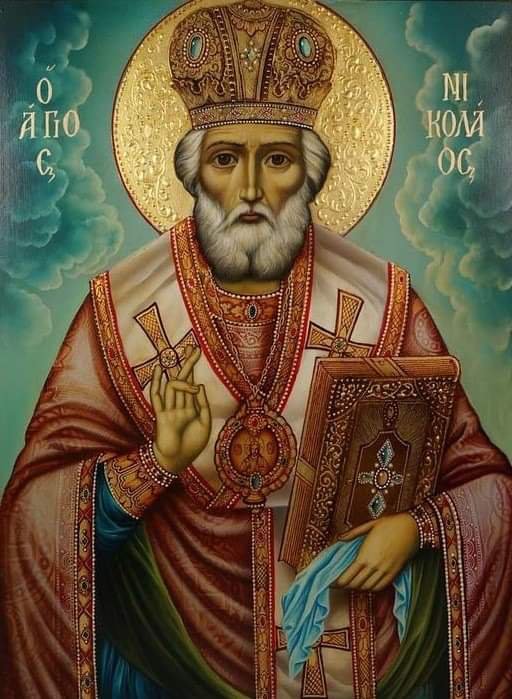
St. Nicholas

Today we commemorate Our Holy Father Saint Nicholas the Wonderworker. This is an excerpt from Fr Thomas Hopko’s ‘The Winter Pascha’ about this wonderful saint and joyous feast.

Following the feast of St. Andrew, prefeast hymns of the Nativity are heard once again on the feast of St. Nicholas, the fourth-century bishop of Myra in Lycia who through the ages had come to be especially connected with the festival of Christ’s birth.
O you who love the festivals,
Come gather and sing the praises of the fair beauty of bishops,

The glory of the fathers,
The fountain of wonders and great protector of the faithful.
Let us all say: Rejoice, O guardian of the people of Myra,
Their head and honored counselor,
The pillar of the Church which cannot be shaken.

Rejoice, O light full of brightness,
That makes the ends of the world shine with wonders.

Rejoice, O divine delight of the afflicted,
The fervent advocate of those who suffer from injustice.

And now, O all-blessed Nicholas,
Never cease praying to Christ our God
For those who honor the festival of your memory
With faith and love.


Sad as it is to see St. Nicholas transformed into the red-suited Santa Claus of the secular winter “holidays,” it is easy to understand why the holy bishop has become so closely connected with the festival of Christ’s birth. The stories about the saint, fabricated and embroidered in Christian imagination over the ages, in various times and places, all tell of the simple faith and love of the man known only for his goodness and love.
The extraordinary thing about the image of St. Nicholas in the Church is that he is not known for anything extraordinary. He was not a theologian and never wrote a word, yet he is famous in the memory of believers as a zealot for Orthodoxy, allegedly accosting the heretic Arius at the first ecumenical council in Nicaea for denying the divinity of God’s Son. He was not an ascetic and did no outstanding feats of fasting and vigils, yet he is praised for his possession of the “fruit of the Holy Spirit… love, joy, peace, patience, kindness, goodness, faithfulness, gentleness, self-control” (Gal 5:22-23). He was not a mystic in our present meaning of the term but he lived daily with the Lord and was godly in all his words and deeds. He was not a prophet in the technical sense, yet he proclaimed the Word of God, exposed the sins of the wicked, defended the rights of the oppressed and afflicted, and battled against every form of injustice with supernatural compassion and mercy. In a word, he was a good pastor, father, and bishop to his flock, known especially for his love and care for the poor. Most simply put, he was a divinely good person.

Like God and like Jesus, St. Nicholas was genuinely good. Real goodness is possible. For, to quote the Lord again, “with men this is impossible, but with God all things are possible” (Mt 19:26). A human being, even a rich human being who believes in God, can be genuinely good with God’s own goodness. “For truly I say to you, says the Lord, “if you have faith as a grain of mustard seed… nothing will be impossible to you” (Mt 17:20-21).

The Messiah has come so that human beings can live lives which are, strictly speaking, humanly impossible. He has come so that people can really be good. One of the greatest and most beloved examples among believers that this is true is the holy bishop of Myra about whom almost nothing else is known, or needs to be known, except that he was good. For this reason alone he remains, even in his secularized form, the very spirit of Christmas.

saintnicholas #stnicholas

Union with God

Intimate Union with God in the Eucharist
In “The Q&A Guide to Mental Prayer,” Connie Rossini writes, “Blessed Marie-Eugène, OCD, says that there are three ways to intimate union with God. The first (in hierarchical order) is the Eucharist, the second is contemplation, and the third is supernatural obedience (obeying authority with the motive of obeying Christ himself).
Fr. Garrigou-Lagrange describes this union with God when we receive the Blessed Sacrament:
“Communion is, therefore, the most perfect act of the interior life, and if we prepare ourselves for it with humility, zeal, and meekness, we shall find there the most efficacious means for union with God. While our body receives the body of Christ, our soul is united to His soul, our intelligence to His light, our heart to the everburning sun of His love. Our Lord unites Himself to us to assimilate us to Himself, to make of us other Christs. Every Communion that is not sacrilegious and sterile increases the degree of charity in us. Who then can measure the effects of daily Communion, above all of fervent daily Communion?”(From “Knowing the Love of God,” Chapter 18)
Fr Kieran Kavanaugh explains in his commentary on The Way of Perfection that, “On account of the presence, St. Teresa prizes the time after Communion as a privileged time for the prayer of recollection.”
If you are not yet receiving infused contemplation, take heart that with each Communion, you are experiencing the highest union with God available in this life. Don’t miss the great gift of prayer after receiving the Eucharist. Be recollected and converse lovingly with Him after Communion.
Daily mental prayer disposes you to have more fervent Communions, and each fervent Communion, in turn, helps to deepen your mental prayer.
Connie continues, “Jesus reserves nothing from you in the Blessed Sacrament. He gives himself fully. If you fully gave yourself to him in preparation for the reception of the Eucharist, you could theoretically become a saint through one Communion. However, very few people would be able to prepare themselves so perfectly without having a deep prayer life, usually one that includes contemplation. More frequently, your reception of the Eucharist becomes more efficacious as your prayer deepens.”

Shared from Facebook group: Authentic Contemplative Prayer

The Foot of the Cross

Although not reflective perhaps of the season, the following passage from Fr. Faber from one of his works that I have been reading speaks beautifully of the unity and alliance of the two Hearts, the Sacred Heart of our Lord and the Immaculate Heart of Mary; two hearts joined so completely in God the Father’s design and in our redemption.
“God vouchsafed to select the very things about Him which are most incommunicable, and in a most mysteriously real way communicate them to her. See how He had already mixed her up with the eternal designs of creation, making her almost a partial cause and partial model of it. Our Lady’s co-operation in the redemption of the world gives us a fresh view of her magnificence. Neither the Immaculate Conception nor the Assumption will give us a higher idea of Mary’s exaltation than the title of co-redemptress. Her sorrows were not necessary for the redemption of the world, but in the counsels of God they were inseparable from it. They belong to the integrity of the divine plan. Are not Mary’s mysteries Jesus’ mysteries, and His mysteries hers? The truth appears to be that all the mysteries of Jesus and Mary were in God’s design as one mystery. Jesus Himself was Mary’s sorrow, seven times repeated, aggravated sevenfold. During the hours of the Passion, the offering of Jesus and the offering of Mary were tied in one. They kept pace together; they were made of the same materials; they were perfumed with kindred fragrance; they were lighted with the same fire; they were offered with kindred dispositions. The two things were one simultaneous oblation, interwoven each moment through the thickly crowded mysteries of that dread time, unto the eternal Father, out of two sinless hearts, that were the hearts of Son and Mother, for the sins of a guilty world which fell on them contrary to their merits, but according to their own free will.”

— Fr. Frederick Faber, The Foot of the Cross.

Shared from Fr. David Abernathy, Pittsburgh Oratory on Facebook.